
Dare County Supervision Types
Parole, probation, and post-release supervision are not interchangeable. Probation is a court-ordered community sentence. A person can be placed on probation without serving a prison term. Parole is a conditional release process for the smaller group still eligible under older or special North Carolina laws. Post-release supervision, often shortened to PRS, is the statutory community phase that follows prison for eligible people sentenced under modern Structured Sentencing. The North Carolina Post-Release Supervision and Parole Commission sets PRS conditions and handles parole decisions, while NCDAC Community Supervision staff supervise people in the community.
A Dare County release can therefore produce several records. The prison record may show an Actual Release Date. The same NCDAC detail may also show an active probation, parole, or post-release status. That is not a conflict. Prison custody ended, but the sentence or community term continues. A county-jail bond release, by contrast, does not show that probation began. The court judgment must establish the legal result.
| Supervision type | How it begins | Best verification |
|---|---|---|
| Probation | A court orders a community sentence or suspends an active term subject to conditions. | NCDAC Offender Search detail, the Dare court judgment, and Community Supervision. |
| Post-release supervision | An eligible person leaves NCDAC prison before the maximum term ends and serves the statutory community phase. | NCDAC Actual Release Date plus the active post-release status and Commission record. |
| Parole | The Commission grants conditional release in an eligible old-law or special statutory case. | NCDAC detail, Commission process information, and published monthly review material where applicable. |
| Discharge | The supervision term and, where the law provides, the sentence end. | Inactive NCDAC detail, supervision end dates, and case-specific agency confirmation. |
Useful terms stay precise. An absconder is a supervisee alleged to have stopped contact or failed to comply. Revocation is a formal action that can return a person to custody. Discharge means supervision has ended. None of these terms should be inferred from a missing search result.
Verify Dare County Supervision
The official starting point is the NCDAC Offender Public Information Search. Its status options distinguish an Active Inmate from an Active Probationer/Parolee and an Inactive person. Choose “All” when the current label is unknown. The state says an offender number is the fastest route, and leading zeroes are optional. A name search can be narrowed by date of birth or age, sex, race, and ethnicity. Identity should be checked against the linked record, conviction data, and known case facts.
Use the full detail rather than stopping at the result list. The incarceration panel and the probation, parole, or post-release panel can describe different parts of the same sentence. A Dare County person may be out of prison yet active in the community. A county-only detainee may have no NCDAC prison entry at all. For that person, the Dare court record is needed to learn whether probation was ordered. The Dare County released-inmate search paths explain how to pair jail, court, and state records when custody history crosses systems.
- Search NCDAC by offender number when known. Otherwise use the full name and only enough personal detail to separate matches.
- Open the linked offender number. Confirm the person from birth information, offense, sentence, and case details rather than name alone.
- Compare Inmate Status with Probation/Parole/Post Release Status. Record the exact supervision type and status shown.
- Review start, end, and actual release fields. Do not treat prison release as the end of community supervision.
- Check the Dare criminal judgment in the North Carolina eCourts Portal when probation or a suspended sentence may be involved.
- Call the current District 1 office for the proper public routing. Do not seek or publish a person’s private reporting schedule.
Note: A current supervision label is useful public evidence, but the responsible office should confirm any unclear or recently changed status.
Dare County District One Routing
Dare County is part of NCDAC Community Supervision Judicial District 1 with Camden, Chowan, Currituck, Gates, Pasquotank, and Perquimans counties. On the research date, the current state directory routed District 1 through Elizabeth City. An older Dare resource sheet lists a Manteo Community Corrections contact. Because office assignments can change, the live state directory is the sound source for current routing. Call before traveling or mailing a time-sensitive item.
The NCDAC Community Supervision directory shows the district structure used for Dare County supervision. The directory view below is a routing aid, not a person-level status record.
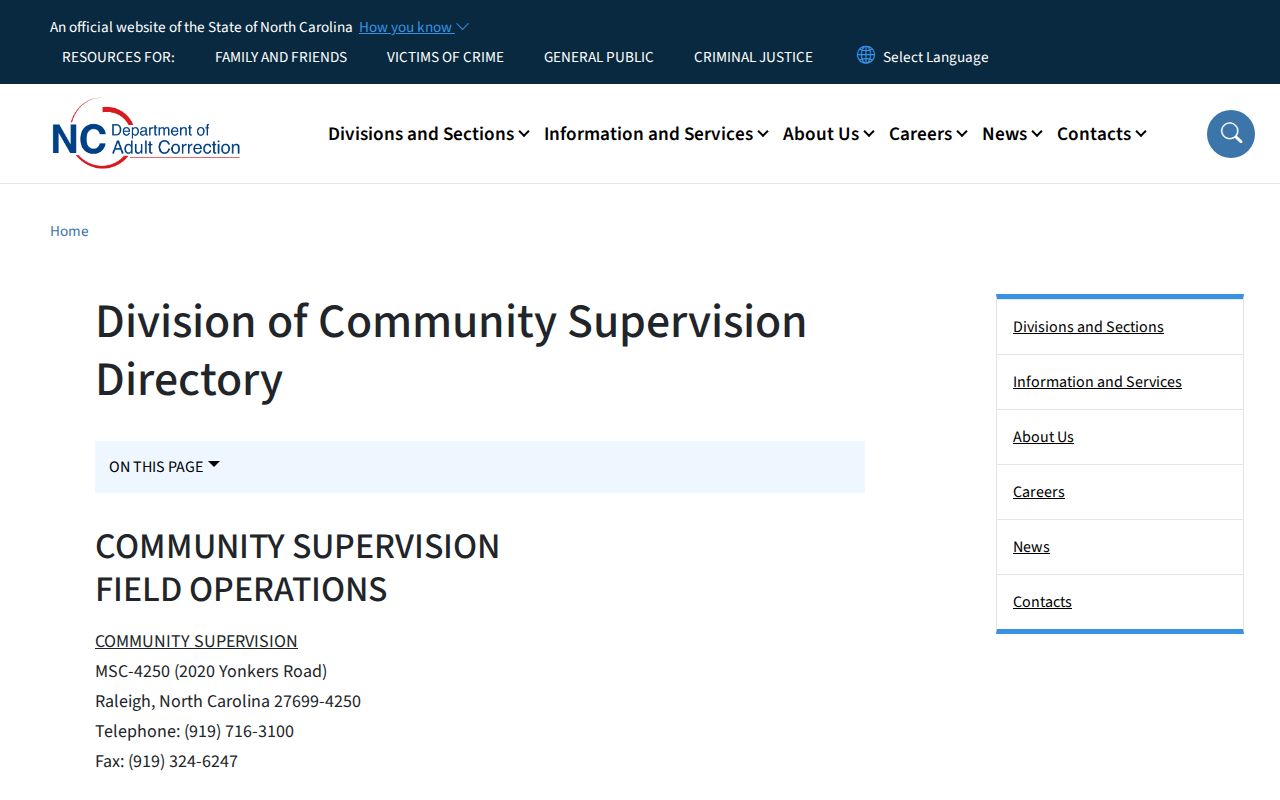
Use the directory to reach the correct office, then use the offender detail and court judgment to verify the nature and dates of supervision.
NCDAC Community Supervision District 1
1023 US 17 South, Suite 3
Elizabeth City, NC 27909
252-621-6129
Fax: 252-331-4841
The district office can route an inquiry, but it should not be asked to disclose a supervisee’s personal appointment times or private case information. Public status and case-specific official records are the proper focus.
Dare County Absconder Records
NCDAC maintains a separate Absconded Probationer Search. It accepts a last name and county of supervision, including Dare. An entry indicates an alleged failure to maintain contact or follow supervision requirements. It does not prove that police executed a warrant, that the person is now in jail, or that a court or Commission revoked supervision. Those later events require their own records.
The official NCDAC absconder form is limited to the supervision question it asks. It is not the Dare County Detention Center roster, and it is not a released-inmate list.
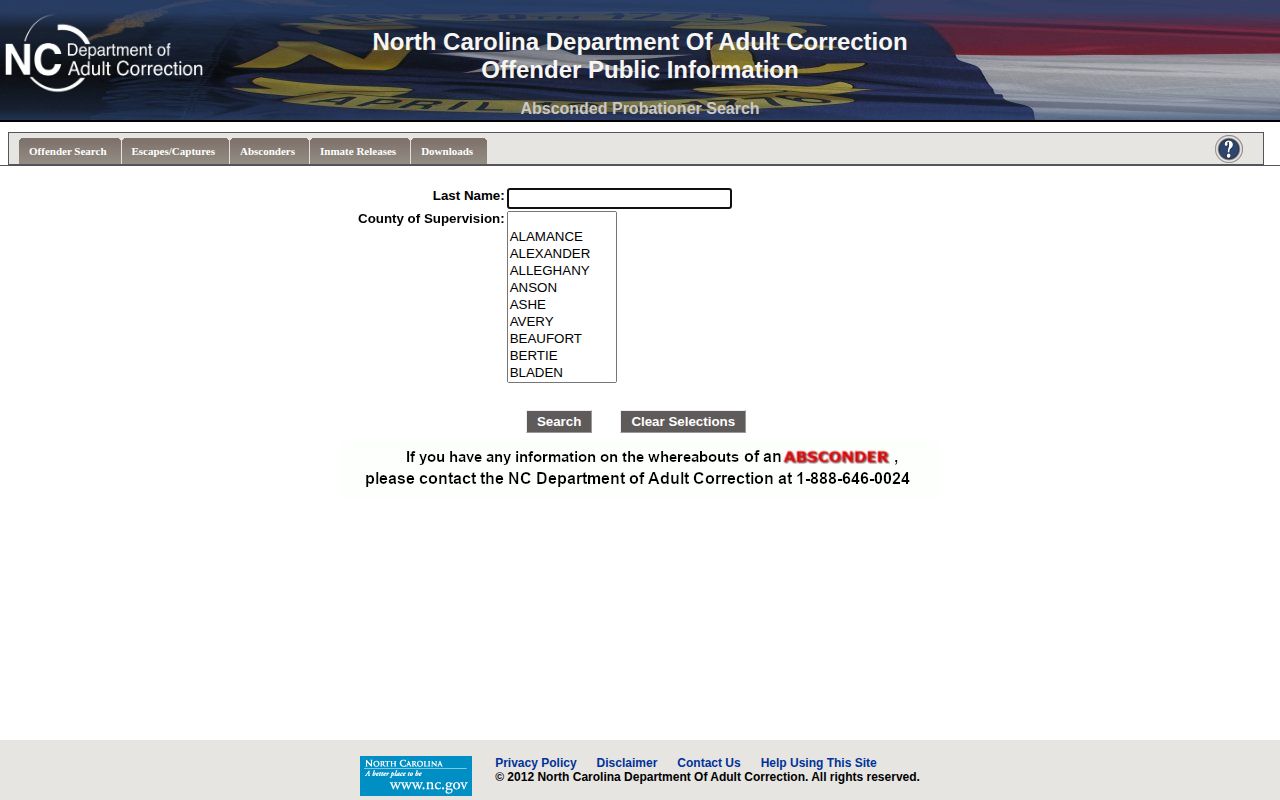
A matching entry should lead back to the full NCDAC offender record and District 1 office. If present custody matters, check the actual custodian rather than treating alleged absconding as an arrest.
Supervision conditions vary by judgment and Commission action. Common categories may address reporting, travel, conduct, treatment, or financial obligations, but the exact binding terms are case-specific. A violation can prompt investigation and formal process. It should not be presumed from rumor, a late update, or an old search capture.
Dare County Parole Record Limits
North Carolina’s parole process differs from the hearing model used in many states. The Commission says it does not hold formal hearings or meet personally with offenders during ordinary review. Commissioners review eligible cases and vote independently. There is no conventional public calendar of future hearing dates. The official Parole Process page is the best description of the procedure.
Structured Sentencing ended ordinary parole for covered offenses committed on or after October 1, 1994. Older cases, certain juveniles sentenced to life with parole eligibility, and special statutory groups require individual review under G.S. 15A-1371. The offense date, judgment, minimum term, sentence type, and special provisions matter. A fixed percentage cannot safely predict eligibility.
The Commission’s Discretionary Parole Reviews are retrospective monthly reports, not a live case calendar. Their terms include approval types, denied decisions, incomplete decisions, and suspended decisions. Even an approval does not establish that physical release has already occurred. The NCDAC Actual Release Date is the stronger prison-exit field. Parole files are generally confidential despite the published summaries.
Post-Release Supervision and Parole Commission
2020 Yonkers Road
4222 Mail Service Center
Raleigh, NC 27699-4222
919-716-3010
Fax: 919-716-3987
Parole.Commission@dac.nc.gov
Dare County Reentry Program Context
Dare County’s fiscal-year 2024–25 opioid-settlement authorization set aside $50,000 for Detention Center “Reentry Programs.” The published description connects the jail population with counseling, rehabilitation entry costs or copays, clothing, and medical or health resources. This is a local reentry finding, not an NCDAC status tool and not proof that a named person took part.
The funding document is time-bounded and provides no public participant intake form. Current availability should be confirmed with Dare County Detention Center at 252-475-9220. Dare Recovery Court and Outer Banks Dare Challenge form a separate recovery layer. They do not keep the official parole, probation, or release record. The distinction matters because help after release and legal supervision are different functions, even when both affect the same person’s return to the community.
For the source and scope, review the county’s opioid-settlement authorization. Ask the jail about current reentry access, while sending status questions to NCDAC.
Dare County Supervision Discharge
Supervision ends through an official discharge or term completion, not simply because a person no longer appears under one search filter. For modern post-release supervision, G.S. 15A-1368.2 states that completion of the supervision period terminates the sentence. Probation and parole have their own judgment, Commission, and case-specific terms. The public NCDAC record may later become Inactive and retain dates and correctional history.
Confirm the sequence: prison or jail departure, supervision start, any change in status, supervision end, and final sentence discharge. A transfer to another custodian interrupts any claim of community release. A return to custody after violation is also a new event. When dates appear inconsistent, request the existing public fields from NCDAC or obtain the judgment rather than choosing the most favorable date.
- Actual Release Date
- The recorded date NCDAC prison custody ended for that event.
- Post-release supervision
- The community phase that can follow prison while the sentence remains active.
- Inactive
- NCDAC’s label for a person formerly active as an inmate, probationer, or both, but not active now.
- Discharge
- The official end of the applicable supervision term or sentence stage.
Note: A release date, supervision end date, and final discharge date can differ without any record being wrong.