
Dare County Release Date Meaning
The NCDAC public record uses the exact label Projected Release Date. It is a calculated future date for the sentence shown, not a promise of community release. An Actual Release Date is retrospective evidence that NCDAC prison custody ended for that event. Even then, the person may begin post-release supervision or move to another custodian. Full discharge can occur later.
A Dare County pretrial detainee has no sentence-based projected date. Bond, a release order, dismissal, commitment, or another court event may change custody. The Dare County Detention Center record supplies the actual local processing time, while the court record supplies the legal authority. A sentenced local misdemeanant may have a calculated completion date, but Dare Detention and the judgment control that calculation, not the NCDAC prison field.
The first task is to name the milestone: pretrial release, completion of a local sentence, departure from state prison to supervision, parole eligibility, transfer, or final discharge. Those dates answer different questions.
Find Dare County Projected Dates
Use the custodian that owns the sentence. For a North Carolina state prisoner, open the NCDAC Offender Public Information Search. Search by offender number when known, or by name with enough detail to separate matches. Open the linked offender number and verify identity through date of birth, conviction, sentence, and incarceration data. Read both the Projected Release Date and Actual Release Date fields when present.
For a county sentence at Dare County Detention Center, call 252-475-9220 and ask about the recorded calculation for the named booking and judgment. Obtain the signed judgment from the Dare County Clerk when the sentence terms are unclear. For pretrial detention, ask about bond or the latest court order instead of requesting a sentence estimate. The Dare County release search gives the separate jail, court, and state record routes.
- Identify the custodian: Dare jail, NCDAC prison, another county, BOP, or ICE.
- Obtain the signed judgment and identify the offense date, sentence type, and each minimum, maximum, or fixed local term.
- Confirm when the sentence began and the amount of credited presentence confinement.
- Determine whether multiple terms run at the same time or one after another, and whether another agency has a hold.
- Read the official Projected Release Date from NCDAC or request the local calculation from Dare Detention.
- Recheck after discipline, program changes, appeal, resentencing, correction, or transfer.
- Confirm departure through the Actual Release Date or the releasing custodian’s record.
Note: A court sentence states the legal term, but the custodian maintains the current administrative credit calculation.
Dare County Sentence Eras
North Carolina has more than one sentencing framework. Structured Sentencing generally applies to qualifying offenses committed on or after October 1, 1994. Older Fair Sentencing and parole-eligible cases use different credit and parole rules. The offense date and judgment must be known before any calculation begins. Applying a modern rule to an old-law prisoner can produce a false date.
For Structured Sentencing felonies, G.S. 15A-1340.13 requires service of the court-imposed minimum term. Earned time may reduce the maximum toward the minimum, but it cannot lower the term below that minimum. The official statute supplies this central limit.
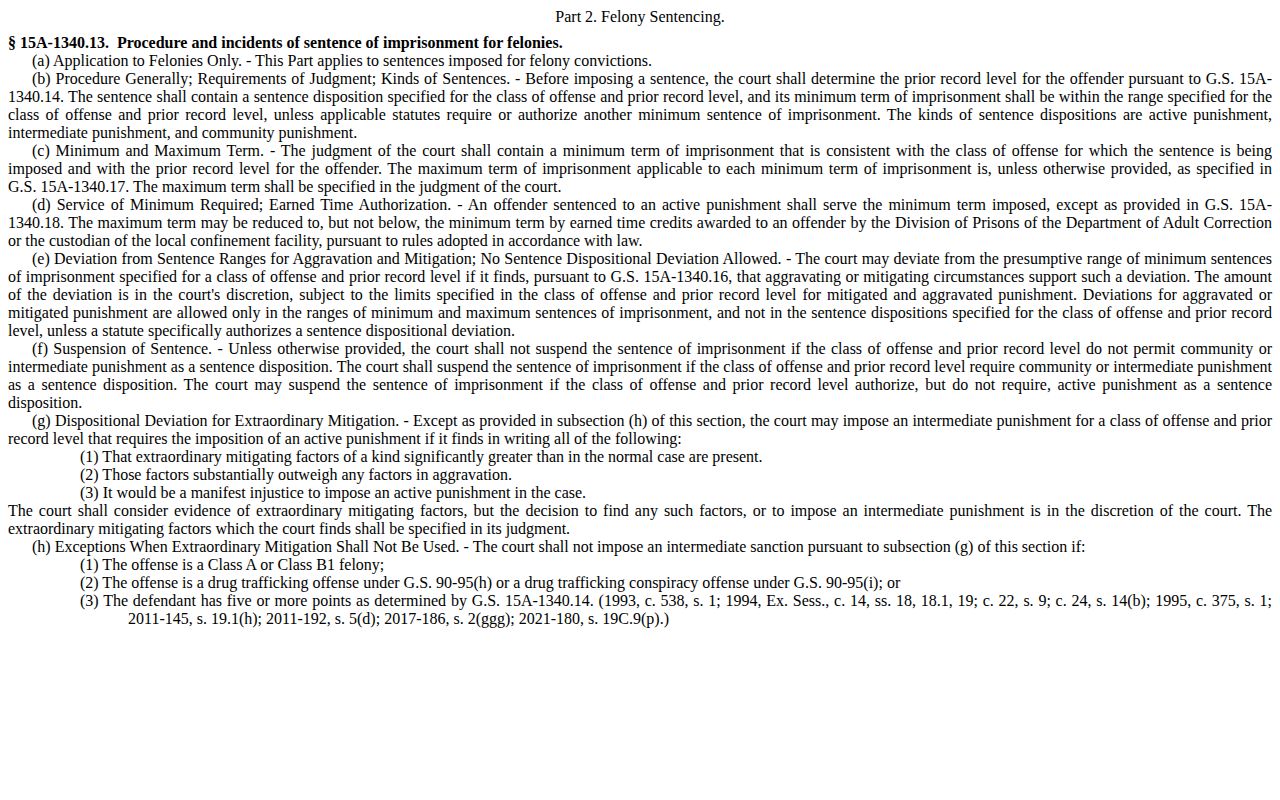
The statute explains why the judgment’s minimum and maximum matter more than a rough percentage applied to a sentence quoted elsewhere.
Older Fair Sentencing rules can include good time described by NCDAC as one day for each day of good behavior, subject to forfeiture, plus merit time in defined circumstances. Those old-law concepts do not transfer to a modern Structured Sentencing calculation. Parole eligibility in an older case also depends on the governing judgment and statute rather than a universal fraction.
Dare County 85 Percent Rule
The common claim that North Carolina is an “85% state” needs care. NCDAC explains that structured minimum terms are ordinarily about 85 percent of maximum terms. That relationship is built into sentencing ranges. It is not a rule allowing every person to subtract 15 percent from any term.
The accurate statement is narrower: a modern Structured Sentencing prisoner generally serves 100 percent of the judicially imposed minimum. Applicable earned time can reduce the maximum toward, but never below, that minimum. Do not multiply a sentence by 0.85. The true projected release date also depends on sentence start, jail credit, concurrent or consecutive terms, credits actually earned or lost, sentence corrections, special offense provisions, and the post-release supervision transition.
This distinction is the research angle most likely to prevent a bad Dare County estimate. A news report may quote only one term. The signed judgment and NCDAC calculation show the legal minimum, maximum, and sentence structure needed for a reliable reading.
Dare County Jail Earned Time
A qualifying activated North Carolina misdemeanor follows a separate local framework. G.S. 15A-1340.20(d) permits earned time under DAC and local-custodian rules, with the combined framework capped at four days per month. G.S. 162-60 provides four days of reduction for each 30 days of faithful qualifying work, education, rehabilitation, or training. The custodian decides whether participation qualifies, and escape or attempted escape forfeits that reduction.
G.S. 148-13 requires DAC earned and good-time regulations to be supplied to and followed by local jail administrators for sentenced jail prisoners. The official statute records that earned-time authority.
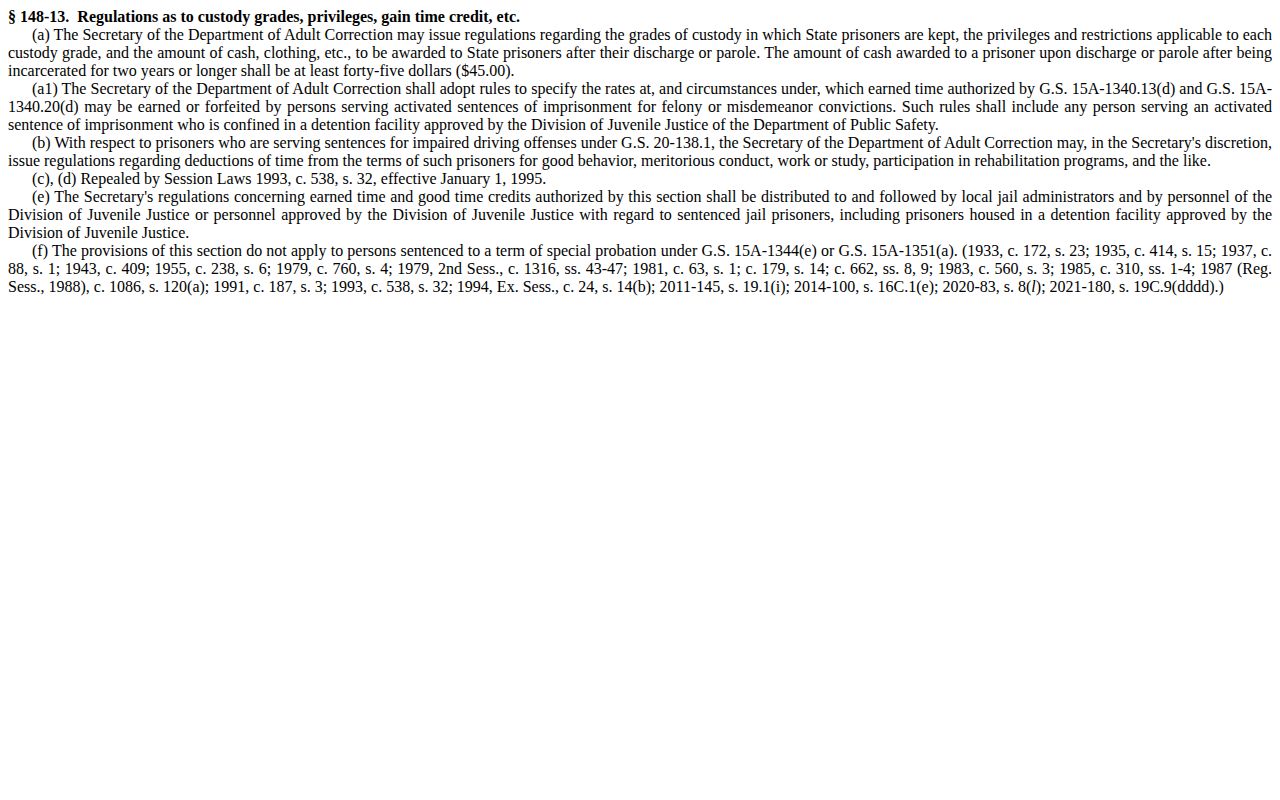
The law supports a possible credit path, not an automatic award to each Dare detainee. Actual participation and the custodian’s calculation remain essential.
A pretrial detainee is not serving the activated local sentence being calculated. Eligibility and credits must not be assumed. G.S. 15A-1355 supplies further rules on sentence commencement and confinement credit, including different treatment for impaired-driving sentences. Dare Detention or the court must answer the named local calculation.
Note: Four days per month is a cap within the qualifying framework, not a credit automatically received by every Dare County inmate.
Dare County Date Changes
A projected date can change while the underlying sentence remains valid. NCDAC identifies earned and disciplinary credit, work or program assignment, discipline, completion, transfer, court vacatur or resentencing, changes in statute or case law, extensions of limits of confinement, and parole factors in old-law cases. A calculator that lacks these inputs cannot reproduce the official result.
| Factor | Possible effect | Source to confirm |
|---|---|---|
| Earned credit | May reduce the maximum toward the lawful minimum when actually awarded. | NCDAC or Dare Detention calculation |
| Discipline or forfeiture | Can remove or recalculate credit and move the estimate later. | Custodian’s current record |
| Program or work change | Can alter future credit accrual or completion timing. | NCDAC or local custodian |
| Court action | Vacatur, resentencing, appeal, or correction can change the legal term. | Signed court order and docket |
| Concurrent or consecutive terms | Determines whether sentences overlap or run one after another. | Judgment and sentence computation |
| Detainer or transfer | May prevent return to the community on the nominal exit date. | Releasing and receiving agencies |
| Old-law parole decision | Can affect a parole-eligible case without changing the sentence maximum. | Commission and NCDAC record |
A detainer is a request or notice from another jurisdiction concerning custody. It can mean a person leaves NCDAC or Dare Detention and goes directly to another agency. That is release from the first custodian, but not release to the community. Ask the office that owns the displayed date whether any hold changes the destination.
Dare County Release Supervision
Projected prison release may mark the start of supervision, not the end of the sentence. Under G.S. 15A-1368.2, the ordinary transition to mandatory post-release supervision is maximum less 12 months for Class B1 through E felonies and maximum less nine months for Class F through I felonies, less applicable earned time. Certain reportable-conviction maximums use 60 months. In the ordinary case, the person cannot refuse this community phase.
Completion of post-release supervision terminates the sentence under subsection (f). Until then, Commission conditions apply, and a violation can lead to reimprisonment. A sound timeline separates prison release, supervision start, supervision end, and full discharge. Parole is different. It concerns eligible old-law or special cases and is not the label for every modern person released under supervision.
- Projected Release Date
- NCDAC’s estimate for the sentence event shown.
- Actual Release Date
- The retrospective date state prison custody ended for that event.
- Post-release supervision
- The mandatory community phase for eligible modern prison sentences.
- Detainer
- A notice from another jurisdiction that can lead to transfer instead of community release.
- Discharge
- The formal end of the applicable supervision or sentence stage.
Confirm Dare County Release Dates
Recheck the official source close to the projected date. For NCDAC, compare the current Projected Release Date with the Actual Release Date and the probation, parole, or post-release status. For Dare County Detention Center, ask for the actual local processing time, release type, and destination. The Dare court judgment explains the sentence or order, but it may not show the final jail-processing minute or the latest credit total.
NC SAVAN can provide a custody-change alert for a participating jail or NCDAC feed. It remains derivative of agency transmissions. Registration and transfer limits are covered in the Dare County VINELink inmate check. If an alert reports transfer, follow the receiving custodian and re-register where required. For a written result, request the existing release record from the agency that held the person.
A defensible answer preserves the source label. Say “Projected Release Date” when that is what NCDAC displays. Say “Actual Release Date” only after the retrospective field appears. For a Dare local sentence, attribute the date to the jail calculation. If a hold exists, state that the nominal date may lead to transfer rather than release to the community.
Note: Confirm the final event with the custodian because a projected date can change until an actual release is recorded.